Rising to the climate challenge brings fresh opportunity for innovation in sustainable technology and the generation of world-leading IP.The UK parliament’s declaration of a “climate emergency” is welcome news. The battle against climate change is being taken more seriously, spurred on by growing public feeling on the issue. The recent Committee on Climate Change (CCC) publication suggests that to achieve a net-zero emission Britain, aviation would become ~50% of total UK household emissions by 2050. Rightly, the report emphasises the huge technological challenge of reducing aviation emissions. A more detailed technical study commissioned by the Department for Transport titled Understanding the potential and costs for reducing UK aviation emissions supports this point.We should take on these technical obstacles, not be defeated by them. Aerospace has a track record of challenging the limits of engineering, driving technological progress that can be exploited more broadly. Economically, the impact of aerospace R&D is twice as great outside the sector than it is within. This underscores the importance of the sector in boosting IP, knowledge and skills in general – things we will need if we are to tackle the climate problem by moving forward, not backwards.Rising to the climate challenge brings fresh opportunity for innovation in sustainable technology and the generation of world leading IP. Aerospace can drive forward advancement in light weighting, thermodynamic efficiency, electrification and AI, to name a few, like few other sectors can. Our recent Global Aerospace Patents INSIGHT reveals the dramatic global trends in aerospace towards electrification, advanced light-weight materials and near-net-shape manufacturing in a race to secure competitive IP that reduces environmental impact, cost exposure and gains competitive advantage.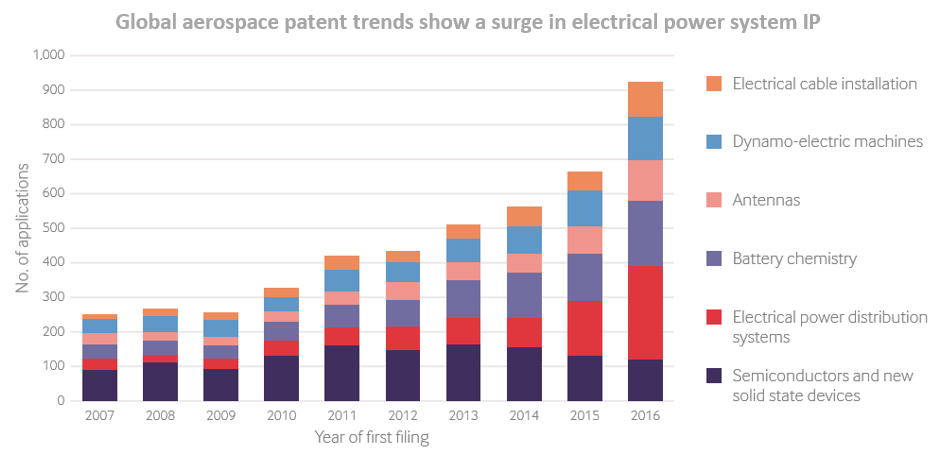 Global aerospace electrical technology patent trends – Source: ATI Global Aerospace Patent INSIGHTBreakthroughs in battery technology, fuelled so far by automotive opportunities, have spiked excitement in urban air transport concepts through technical viability of electric vertical take-off (eVOTL) and sub-regional aircraft – a potentially disruptive technology push. ATI patent analysis evaluated clear trends demonstrating this surge eVTOL technology development globally. Therefore, electric aviation may enable a more distributed aviation network through reduced operating costs, alleviating ground transportation in the long term, and progressing safe zero-emission technology for larger commercial aircraft in the short term.
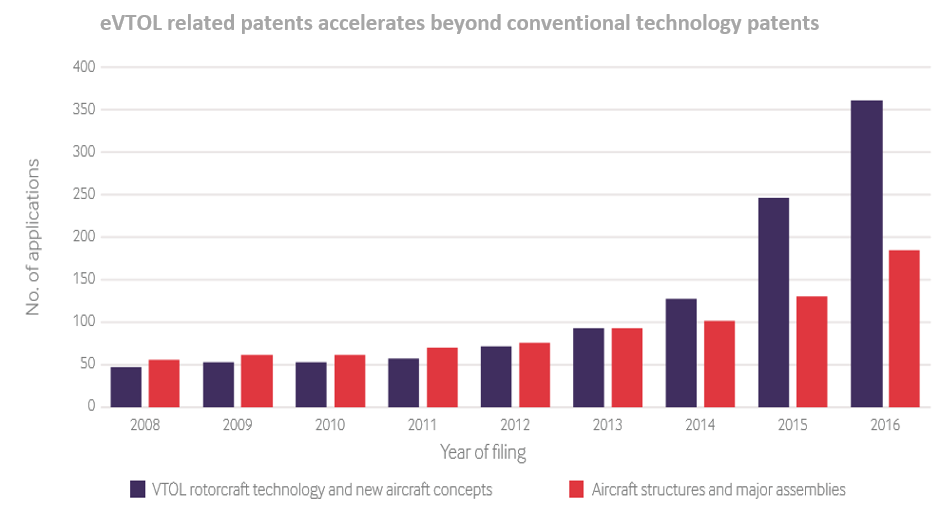 Global aerospace patent trends by technology – Source: ATI Global Aerospace Patent INSIGHTBoth reducing environmental impact and raising UK competitiveness through IP creation underpin our investments in aerospace research and technology. 70% of the portfolio of ATI projects contains the objectives to reduce environmental impact and increase fuel efficiency with over £930m of total ATI project cost has been invested directly in these key objectives.ATI analysis of the global aerospace patent landscape reveals the increasingly global nature of the supply chain and intense competition for securing valuable IP. However, the UK has been slower than other nations to protect IP in the expanding far east. Generally, large multinational aerospace incumbents are responding to emerging opportunities by protecting IP in countries such as China, Korea and India, whilst equally attempting to mitigate the threat to future market share. Also, given the size of the UK aerospace industry, it also makes a relatively small contribution to the global aerospace patent scene. However, the perceived quality of UK patents is thought to be amongst the highest measured.The ATI has also produced INSIGHT papers on Electrical Power Systems technology, Additive Manufacturing, Composites and many more which all contribute to the vision of sustainable air transport. Future ATI INSIGHTs will look at aircraft autonomy, considered central to streamlining aircraft operations and making further efficiency savings.The UK air transport industry generates £35bn of revenue, 90% of which is exported, equating to over £10bn in value-add to the UK economy. The ATI remains committed to growing this high-value industry whilst driving sustainability which, we believe, coalesce seamlessly into a single positive vision for the future of UK air transport; implemented through thought leadership and strategic technology investment. Ultimately, generating intellectual property ahead of competition that increases long lasting UK competitive prospects.
Climate Change & UK Competitiveness
Related articles

Blue sky thinking: How the world’s most ambitious contrail avoidance trial got off the ground
ATI Head of Technology – Sustainability & Strategy, Adam Morton, retraces the journey of the world...
10th September 2026

New ATI INSIGHT paper defines aerospace’s battery requirements
Published as experts meet for the first day of the Faraday Institution Conference 2026, INSIGHT: Aer...
8th September 2026

ATI Impact Report 2026: Investing in productivity, jobs and growth
Highlighting major technology and industrial milestones, growing regional impact, and the role of AT...
26th August 2026