DELIVERING NEXT GENERATION AEROSPACE TECHNOLOGIES


ULTRA-EFFICIENT TECHNOLOGIES
The ultra-efficient roadmap defines the technologies required to enable major fuel burn and emissions reductions including aerodynamics, propulsion, lightweight structures and systems. These technologies leverage national strengths, especially in engine and wing design, to boost competitiveness, deliver future aircraft performance and power growth.
Targets
| SINGLE-AISLE | WIDEBODY | |
|---|---|---|
| Fuel burn | -25% | -20% |
| Aircraft weight | -20% | -12% |
| Aircraft drag | -10% | |
| Engine time on wing | 10,000 cycles | 3,000 cycles |
| Noise | -65% | |
ULTRA-EFFICIENT TECHNOLOGIES ROADMAP
Filter
Gas turbine durability
High-pressure ratio small core
Low-noise propellers and open fans
Scalable, high power gearbox
MW hybrid systems
More-electric gas turbine
Advanced controls
Low-noise propulsion and nacelle architectures
Low-emissions combustor
Low-speed composite fan
High-temperature materials and coatings
Auxiliary power generation
Durable materials
MW scale distributed power system architectures
Alternative fuels gas turbine enablers and architecture
Alternative gas turbine architectures
SAF compatible materials and fuel system components
Electrical actuation systems
High-voltage power systems
Fuel systems
More-electric, lightweight landing systems
Cyber-secure avionics
High power density non-propulsive electrical machines
Bleed air-driven environmental control system
Bleedless environmental control system
Lightweight sustainable interiors
Cabin experience and connectivity
Fibre-optic and photonics based avionics
High-integrity lightning strike protection
Low-power ice detection and protection
AI-enabled onboard systems
Advanced systems for novel airframe configurations
Quantum-enabled avionics
High-aspect ratio wings
Airframe and propulsion integration
Moveables and structures
Wing assembly and major component production
Folding wings and semi-aeroelastic hinges
Load alleviation and flutter supression
Laminar flow structures and devices
Large thermoplastic aerostructures
Future wing and airframe configurations
Propulsion integration for new configurations
Low-drag surface materials

ZERO-CARBON EMISSION TECHNOLOGIES
The UK drives revolutionary research to secure long-term competitiveness in breakthrough technologies such as high-power electrification and hydrogen. The Zero-Carbon Technologies Roadmap defines the technologies needed to build on current progress and sets development milestones through 2050.
Targets
| 2030 | 2045 | |
|---|---|---|
| Fuel cell system performance | 2.5kW/kg | >5.0kW/kg |
| Aerospace battery energy density | 250Wh/kg | >500Wh/kg |
| Electric propulsion unit performance (MW plus scale) | 10kW/kg | 15kW/kg |
| Cryogenic H2 tank gravimetric efficiency | 40% | 75% |
| Electrical power system architecture | High-voltage | Cryogenic |
ZERO-CARBON TECHNOLOGIES ROADMAP
Filter
Battery management system
Fuel cell control system
High cell-to-pack efficiency battery pack design
GH2 sensing and leak detection
High-performance Li-ion aerospace battery
Sub-MW fuel cell system
Hydrogen capable materials
LH2 sensing
Durable insulated cryogenic pipes
Isolation capable cryogenic valves
Electric compressors for large fuel cell systems
LH2 storage tanks
Durable cryogenic pumps
Low-drag efficient fuel cell thermal management
MW class fuel cell system
Future aerospace batteries
Dry wing configurations
Hydrogen combustor
Hydrogen gas turbine integration
Magnetic materials for electrical machines
High-voltage power systems
Lightweight electric propulsion unit
Cryogenic heat exchanger
Integrated energy management system
Cryogenic electrical power conduits
Rare earth free motor
Cryogenic propulsion unit
Cryogenic power distribution

INDUSTRIAL PRODUCTIVITY AND COMPETITIVENESS
Industrial competitiveness technologies are essential to realise the ultra-efficient and zero-carbon aircraft sustainability and economic benefits and maximise UK
aerospace’s growth. The roadmap defines research priorities to deliver the advanced materials, design methods and competitive manufacturing processes necessary to scale to meet rising production demands and advanced products for next-generation aircraft.
Targets
| 2030 | 2045 | |
|---|---|---|
| Gross value added per employee | +15% | +80% |
| Resource intensity in manufacturing | -10% | -60% |
| Rate capability for single-aisle | 75 | 100 |
| Design and manufacturing lead time | -10% | -50% |
INDUSTRIAL COMPETITIVENESS TECHNOLOGIES ROADMAP
Filter
Rapid validation and qualification of novel alloys and processing
Life and performance enhancing coatings
Resilient composites
Metal matrix composites for high loads
Sustainable composite matrices for high‑rate production
Efficient qualification of new materials
Sustainable alloys and composites
Integrated material supply chains
Performance enhancing hybridised materials
High‑fidelity, rapid design and simulation methods
Aero and noise simulation for novel architectures
Aerodynamic and aeroacoustic testing
Joining of materials
Icing modelling and analysis
Methods for composite and metallic architectures
Automated, data-enabled, design for X tools
Rapid product qualification and certification
Trusted AI in design and validation
Quantum in design and simulation
Multiphysics design tools
Integrated intelligent structures
Advanced design and manufacturing of unitised structures
Evaluation and real time data analytics
Determinate assembly for large aerostuctures
Rate-enabling subtractive manufacturing
Rapid large volume metrology
Scalable near net shape metallics
Sustainable composite and metallic processing
Rate-enabling equipment, tooling and jigs
One-way assembly and enablers
High-rate manufacturing systems
Rapidly adaptable manufacturing lines
High-rate assembly and disassembly of propulsion and systems
Digital manufacturing and supply chains
Autonomous connected facilities
Extended laminar flow manufacturing technologies
Material-to-product operational digital passport
Prognostic and health management
Tools and processes for maintenance productivity
AI assisted assessment and decision
Repair methods for advanced materials
Composites and metallics recycling

NON-CO2 TECHNOLOGIES
The first-of-its-kind Non-CO2 Technologies Roadmap reflects the UK aerospace sector’s collective view of the research actions needed to improve understanding and reduce broader atmospheric emissions from aircraft.
Targets
| NOx reduction against pre-2000 engines | 90% |
|---|---|
| Reduction in nVPMs mass and number | 90% |
| Achieve consensus on reductions in other particulates | |
| Achieve consensus and set aims for SOx, water vapour and contrails | |
NON-CO2 TECHNOLOGIES ROADMAP
Filter
Modelling / testing of fuel hydro treating / de-sulphuring influence
Modelling / testing of fuel aromatic content influence
Modelling / testing of SAF particulates influence
SAF pathways data for trade studies
Drop-in versus non-drop-in SAF data for trade studies
Modelling / testing of optimal SAF blends utilisation logic
Modelling / testing of hybrid fuels utilisation logic
Fuel optimisations based on findings
Water vapour release systems and controls
Engine combustion
Engine controls
Fuel management for hybrid and dual fuel systems
Technology enablement based on findings
Data to inform particle size as nuclei for contrails
Modelling / testing of NOx at cruise altitude
Modelling / testing of water vapour from H₂ combustion
Modelling / testing of water vapour from H₂ fuel cells
Modelling / testing of combustion correlation with contrails
Climate data to understand CO₂ and non-CO₂ trades
Through-life modelling of emissions
Data management systems for flight operations
Operational testing / implementation based on findings
Downloads Get the definitive strategy
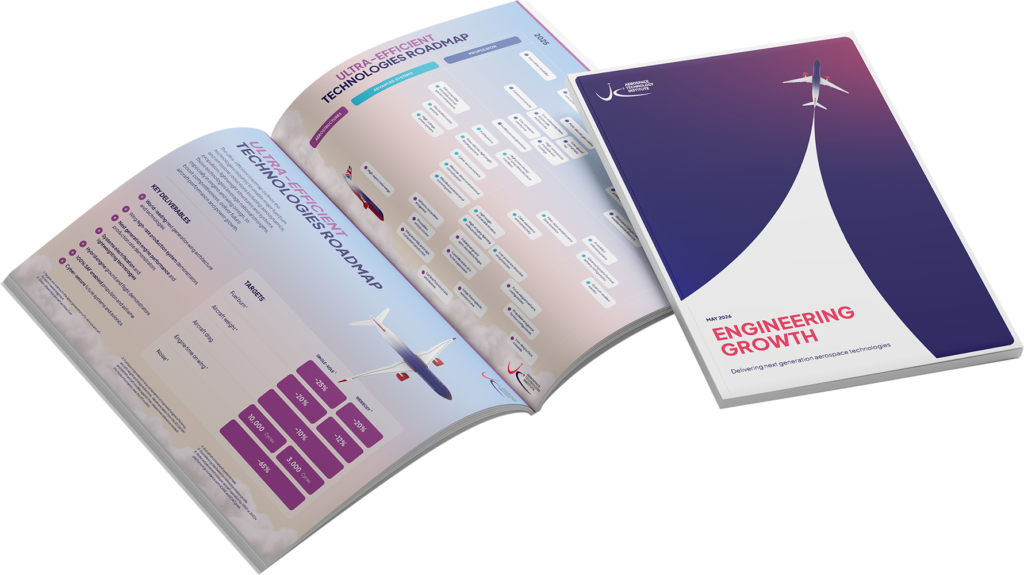
The ATI’s UK aerospace technology strategy sets out a detailed vision for growth, featuring technology roadmaps for ultra-efficient, zero-carbon, industrial competitiveness and non-CO₂ technologies. Download the full strategy to explore the evidence, analysis and investment opportunities driving the UK’s aerospace ambition.