Zenotech
Aerospace Cloud Services

This project set out to tackle the key pain points for the aerospace sector in using cloud HPC to improve efficiency and turnaround times, while maintaining cost-effectiveness, commercial compliance and security. The results are game-changing offering aerospace simulation-based design teams access to cloud HPC capability on-demand, cost-effectively and securely.
SMEs, Zenotech and CFMS, collaborated with aerospace leaders on a project to improve the competitiveness of the UK’s aerospace simulation-based design by enabling access to cloud high performance computing (HPC) capability cost-effectively and securely.
This project developed hybrid cloud access technology for model-based systems engineering and complex computational workflows with easy process integration and commercial policy compliance. Parallel tasks running on CPUs and GPUs with secure, controlled data access used resources from UK HPC centres at Cambridge University, Oxford University, STFC and CFMS, as well as cloud computing providers Amazon AWS, Oracle and Google.
The project was inspired by the need for hybrid cloud and HPC to support future Model-based Systems Engineering (MBSE) and Multi-disciplinary Design Optimisation (MDO). It responded to the fact that aerospace requirements for HPC are not necessarily the same as for other engineering applications as the aerospace sector places a specific focus on data provenance and security. There is also a necessity for rapid scalability of resources to address large sets of related analysis, such as the concurrent evaluation of thousands of design points in an aerodynamic dataset.
At the start of the project large-scale engineering use of cloud and on-demand computing resources was commercially attractive. The prices were low enough to make most internal computing costs uncompetitive (when support services and accommodation were included). The barriers to adoption were concerns regarding export control, software license management, data transfer management and data security.
More recently, commodity cloud computing prices have been rising to the point where it makes good commercial sense for consistent, high volume, highly parallel computing payloads to be run on internal clusters. This makes the case for dedicated internal teams and refresh cycles designed to take advantage of the significant price performance benefit of the latest hardware.
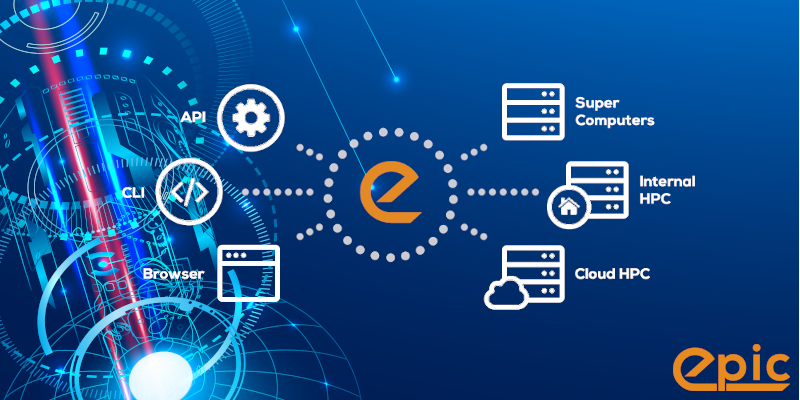
This landscape with its challenges and opportunities formed the basis for the technological development of EPIC. The key developments to the platform included:
- Organisational user and budget control
- Easy workflow integration using the fully featured API
- A simple interface for job creation, resource selection and monitoring
- Support for third party software licenses
Because aerospace industrial workloads are rarely constant, a hybrid model is attractive – combining the stability and configurability of an internal cluster with the burst capacity of the myriad range of suppliers.
Security is vital for the aerospace industry and this project developed hybrid cloud access technology for model-based systems engineering and complex computational workflows with easy process integration and commercial policy compliance.