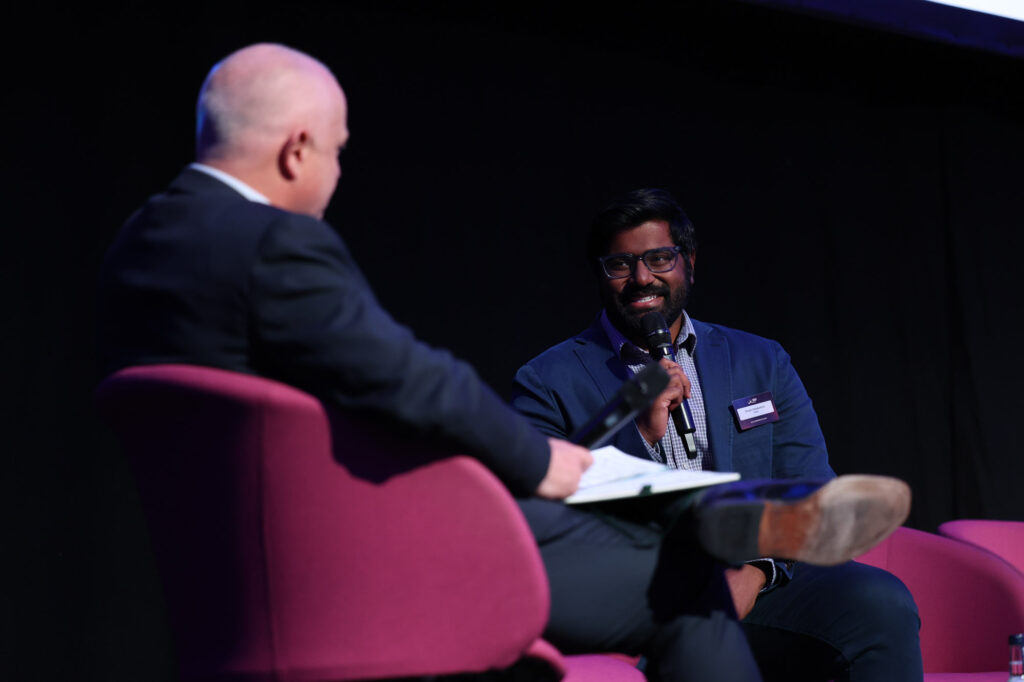
Closing Day Two of the ATI Conference last week, the ATI’s Head of Technology for Sustainability and Strategy, Adam Morton, was in discussion with Dinesh Sanekommu, Google’s lead on Climate and Energy Research. Drawing on Dinesh’s deep experience in applying AI techniques to some intractable problems in medicine, low-carbon energy and climate, the plenary session focused on how AI can help address a key sustainability issue for aviation.
The latest research indicates aviation may account for about 3.5% of anthropogenic radiative forcing, with contrails accounting for around half of this effect. At the same time, only a small proportion of all flights, possibly 2-3%, are responsible for 80% of that contrail warming. This is because the vast majority of flights do not encounter Ice Super Saturated Regions (ISSRs), where all the necessary conditions for persistent contrails combine. Given that ISSRs are relatively thin layers in the atmosphere, it is feasible to plan flight-routes with small altitude changes to fly above or below them.
Dinesh has been leading Google work in this area for a number of years, alongside organisations such as American Airlines, EUROCONTROL and Breakthrough Energy, applying AI not only to help predict where ISSRs will occur but then analysing the resulting avoidance trial data. It is hoped that in future this improved understanding will help airlines avoid contrails, with little or no increased fuel burn or carbon emissions.
The session covered a range of topics, including:
- the current work of Google’s London-based experts on addressing climate issues using AI and other digital techniques;
- the potential cost advantages of altitude-based contrail avoidance;
- the scope to apply AI in new ways to improve contrail identification, tracking and measurement;
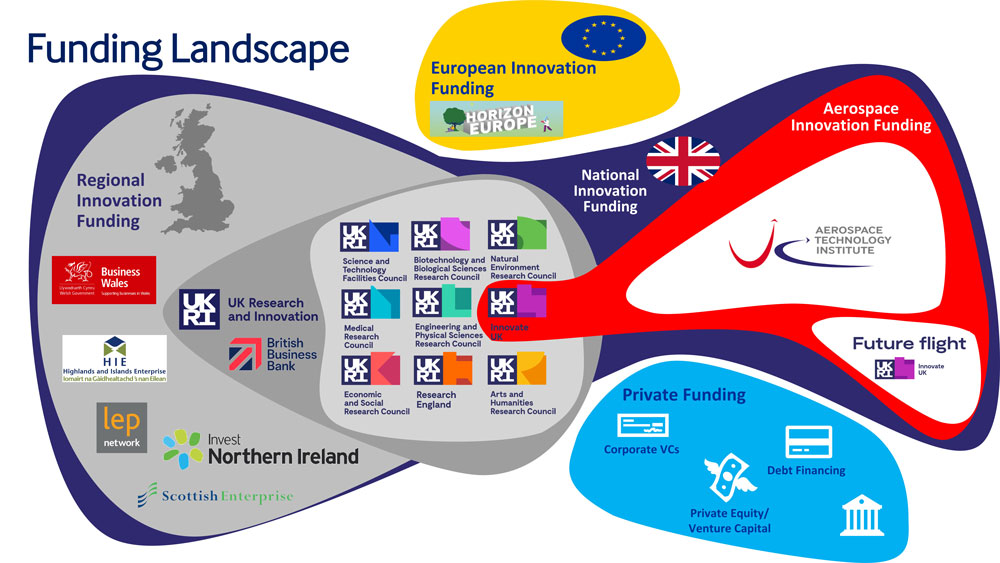
- the natural advantages the UK has in conducting large-scale avoidance trials, thanks to its geography, academic expertise, the role of NATS in managing air traffic in vast swathes of the North Sea, and access to public and private sector funding;
- the level of ambition the UK could show with future contrail avoidance trials, as reflected in the work of the UK’s Jet Zero Taskforce.
The session also touched on wider opportunities for AI to improve sector sustainability. Here, Dinesh drew parallels between Google’s use of AI to accelerate development of their latest generation of chips with scope to deliver complex gas turbine and aircraft systems in our own industry.
Dinesh summed up his overall message: “The world is changing; we need to be more risk-on”. Adam Morton said: “We should take these concluding words as a call to action for the UK: to be ultra-ambitious in plans for future contrail avoidance trials, with the aim to build such concepts into routine UK flight planning in the 2030s”.