Various types of support exist for organisations in and around the aerospace sector but making sense of the funding landscape can be an onerous task. This brief overview will help you make better informed decisions on your next step towards securing research and innovation funding and growing as a business.
Overview
This resource provides a non-exhaustive overview of an ever-changing landscape, presenting the most relevant public and private funding opportunities for companies operating in the aerospace sector. This is an updated version of our earlier funding landscape overview and now includes specific funding sources for hydrogen-related technologies. This information is accurate as of the time of publication, November 2025.
For aerospace innovators in the UK, funding support is available from regional, national, and European funding sources, as well as various private funding options. While the funding landscape continues to evolve, the growing emphasis on sustainable technologies, such as hydrogen, presents exciting new opportunities for innovators.
For a visual summary of funding opportunities, see the graphic below.
Please note that ATI is not responsible for the content of the links to third-party websites included in this resource.
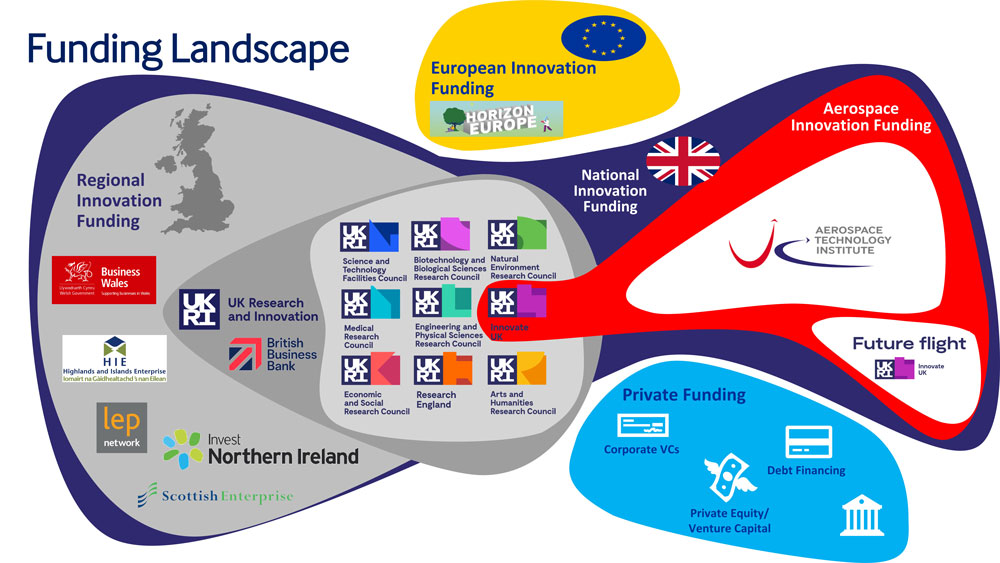
Regional Funding
On a regional scale there is funding and support available from the devolved administrations, as well as funding from city-wide and region-wide councils and organisations that specialise in providing support for local existing and aspiring businesses – some regions have an aerospace focus and can provide more specialised support.
Business Wales can help businesses in areas such as investing in R&D, introducing new techniques and technologies in design and manufacturing, protecting assets through intellectual property (IP) rights, and accessing facilities and expertise. Funding and Innovation Vouchers are available for all phases of research and development, and support is offered for applications to other UK and European funding sources. The SMART Innovation programme can also support SMEs interested in accessing consulting expertise and financial support in design and manufacturing, with areas of support including Conceptual Design, Engineering Design and Rapid Prototyping.
Scottish Enterprise and Highlands and Islands Enterprise are the two primary economic development agencies in Scotland. They offer a multitude of services to support and encourage innovation, business growth, meeting sustainability targets and investment in capital. The Scottish National Investment Bank has demonstrated its commitment to sustainable aviation by investing £20 million in ZeroAvia, a company developing hydrogen-electric propulsion systems. This investment aims to bolster Scotland’s aerospace supply chain and supports the establishment of a manufacturing facility within the country.
Scottish Enterprise has several relevant funding mechanisms, including
- SMART: SCOTLAND grants provide small and medium-sized enterprises (SMEs) to carry out feasibility studies for research and development projects. These studies help businesses assess the technical and commercial potential of innovative ideas before committing to full-scale development.
- Regional Selective Assistance funding is available to businesses undertaking capital investment projects that create or safeguard jobs, particularly in areas of economic need. This funding supports growth that contributes to a greener economy and regional regeneration.
- Research and development grants are designed for businesses that develop innovative products, processes, or services, or significantly improve existing ones. These grants help accelerate industrial research, prototyping, and testing, bringing new ideas closer to market.
An overview of grant funding available from Scottish Enterprise and other relevant funders is available here: Featured business grants and funding calls – Scottish Enterprise (scottish-enterprise.com)
Invest Northern Ireland (Invest NI) is Northern Ireland’s regional economic development agency. It is a non-departmental public body (NDPB) of the Department for the Economy (DfE). It promotes business growth and inward investment, innovation, research and development and in-company training, encourages exports, and supports local economic development and company start up. Invest Northern Ireland offers innovation vouchers and special support to organisations new to R&D funding.
Invest NI’s Project Definition support offers up to £50k towards the cost of planning and defining your R&D project, allowing you to reduce your project’s risks and identify its costs and potential benefits. You can also use Project Definition to help scope out a collaborative R&D project and apply for either an Invest NI Grant for R&D or external funding, such as Innovate UK. Invest NI Grant for R&D offers both advice and financial support to help you develop your idea into a successful product, process or service ready for commercialisation.
In England, local institutions play an important role in supporting businesses through grant funding, advice, and other bespoke support.
Local Enterprise Partnerships (LEPs) are partnerships between local authorities and businesses to help determine local economic priorities and lead economic growth and job creation within the local area. A complete list of each of the 38 LEPs, with a link to their respective websites can be found here: The LEP Network | Supporting all 38 LEPs across England. UK Government has confirmed the end of central government core funding for LEPs from April 2024. LEP functions will be integrated into local authorities and Combined Authorities. Combined Authorities and local authorities will increasingly deliver local growth funding for businesses in future.
Combined and Mayoral Combined Authorities (MCAs) involve two or more councils collaborating to serve a region. They are locally operated and are usually agreed with national government through a devolution deal. As part of the government’s broader devolution strategy, the functions of Local Enterprise Partnerships (LEPs) are being integrated into local democratic institutions, including local authorities and Combined Authorities. Examples include the Greater Manchester Combined Authority, led by Mayor Andy Burnham, and the West Midlands Combined Authority. New MCAs have been established in the East Midlands and North Yorkshire. A list of established and upcoming MCAs is available here.
LEPs, MCAs and local authorities offer various types of types of support for business and innovation, including capital funding, R&D grants, and business advice. For instance, the D2N2 Local Enterprise Partnership (LEP) offers a Funding Tracker that synthesises funding announcements from across the UK government, providing businesses with up-to-date information on available funding opportunities. Additionally, the D2N2 Growth Hub provides guidance on accessing funding and support for business growth, including programmes aimed at innovation and low-carbon initiatives. Many local programmes are supported by the £2.6bn UK Shared Prosperity Fund, which is delivered in England by Mayoral Combined Authorities and the Greater London Authority, and lower tier or unitary authorities elsewhere.
LEPs and MCAs in the East Midlands, Northeast, Northwest, West Midlands, West of England, and Yorkshire and the Humber also provide Made Smarter adoption support. This provides grants and specialist advice to help SME manufacturers adopt digital technologies.
The Regional Aerospace Alliances provide support for businesses in the aerospace, aviation, and related sectors. They can support businesses in accessing funding sources and tend to have a geographical focus on helping businesses based in or looking to move to their home region. These include:
- Midlands Aerospace Alliance
- Northwest aerospace alliance
- West of England aerospace forum
- Farnborough aerospace consortium
- Aerospace Wales
National funding
The following is a list of national bodies which provide cross-sector funding. Competitions and challenges are periodically set by funding bodies and are open to those who meet the specific eligibility criteria. Funding is awarded competitively.
UK Research and Innovation (UKRI) is the primary national funding agency investing in science and research in the UK. Operating across the whole of the UK with a combined budget of £8.8 billion for 2025-2026, UKRI brings together the 9 Research Councils, Innovate UK and Research England.
UKRI’s funding finder provides an overview of open competitions.
A part of UKRI, Innovate UK is the national innovation agency, specialising in providing innovation funding for industrial research across all sectors, technologies and regions. Innovate UK helps businesses grow through the development and commercialisation of new products, processes, and services. This is achieved primarily by providing support, grant funding and connecting businesses with partners and expertise.
Regarding grants, Innovate UK provides a variety of funding opportunities, the scope of which may be relevant to aerospace organisations. The most up-to-date opportunities are available here. Aerospace-specific funding is delivered through the ATI programmes, further details of which are below.
Innovate UK Smart Grants, which provided funding for projects with significant potential for economic impact and commercialisation, have been paused as of January 2025. Businesses are encouraged to explore alternative funding options through Innovate UK’s other programmes and competitions.
Innovate UK also offers Innovation Loans – Future Economy, providing between £100,000 and £2 million to UK-registered SMEs for late-stage R&D projects with strong commercial potential. These loans support the development of innovative products, processes, or services across various sectors, including hydrogen technologies, facilitating the journey from concept to market.
Knowledge Transfer Partnerships (KTPs), supported by Innovate UK, enable businesses to collaborate with universities or research institutions to deliver innovative projects and drive growth. KTPs provide businesses access to academic expertise and a dedicated KTP Associate (a graduate working on the project). Projects typically last between 12 and 36 months. Innovate UK funds up to 67% of the project costs for SMEs and 50% for larger companies, with businesses covering the remainder. More information on eligibility and application guidance can be found on the UKRI KTP website.
The Catapult Network consists of nine Catapult centres across 65 locations, with government funding of £1.6 billion currently confirmed until 2028. The centres are designed to accelerate the application of research into specific fields of science and technology. They provide businesses of all sizes with access to facilities and expertise, which enables them to test, demonstrate and improve their ideas and products. By encouraging collaboration between industry, government, research organisations and academia, the Catapults create innovation environments in key sectors.
Each Catapult offers different facilities, programmes and support, including some which are explicitly targeted at smaller businesses.
For aerospace companies, some of the relevant Catapults are:
- High Value Manufacturing (HVMC) including the Advanced Manufacturing Research Centre (AMRC), the Centre for Process Innovation (CPI), the Manufacturing Technologies Centre (MTC), National Composites Centre (NCC), the National Manufacturing Institute Scotland (NMIS), and Warwick Manufacturing Group (WMG). While the HVMC does not offer grants or direct financial support, it can help develop funding proposals and provide support with introductions to investors.
- Connected Places Catapult (CPC) runs the Future of Air Mobility Accelerator in partnership with the Future Flight Challenge and Industry partners, and launched the Freight Innovation Fund, one of a number of Accelerator Programmes CPC deliver throughout the year. CPC also partners with the Department for Transport’s (DfT) Transport Research and Innovation Grants (TRIG) to fully fund proof-of-concept projects aiming to improve the transport system. The TRIG is open to SMEs, universities, and large businesses. In addition, CPC is an Innovation Partner of the DfT.
- Digital Catapult has the mission of accelerating the adoption of advanced digital technologies to solve industry challenges in a variety of sectors including aerospace and manufacturing. Funding opportunities for digital adoption projects include Made Smarter Innovation | Digital Supply Chain Hub, which is looking to address small and medium-size enterprises’ (SMEs’) supply chain challenges with funding of up to £100,000.
- The Energy Systems Catapult (ESC) supports the development of low-carbon energy systems, including hydrogen technologies. While ESC does not directly provide funding, it offers a range of support to organisations innovating in hydrogen. This includes guidance on technology development, market positioning, and partnerships, as well as contributing to policy and market frameworks that enable the integration of hydrogen technologies into the energy system. The ESC also engages in collaborative projects, such as the Hydrogen Innovation Initiative, to help scale and de-risk hydrogen technologies.
The Engineering and Physical Sciences Research Council (EPSRC) is one of UKRI’s nine Research Councils, and the main funding body for research and training in engineering and the physical sciences. EPSRC invests more than £850 million a year in a broad range of subjects – from mathematics to materials science, and from information technology to structural engineering. EPSRC funding is aimed at fundamental research and low TRL academic projects. EPSRC also funds the Faraday Institution, which works on early-stage battery research.
In addition to its targeted funding initiatives, the EPSRC also offers flexible Standard Research Grants. These grants provide funding for a wide range of research projects across engineering and physical sciences. Applicants are encouraged to tailor their requests based on the unique needs and objectives of their projects, as there is no fixed funding limit or project duration.
Typically, EPSRC covers 80% of the full economic costs of a project, with proposals evaluated on their quality, importance, and potential impact. Applications are accepted on a rolling basis, although some specific calls may have deadlines. For detailed guidance, visit the EPSRC Standard Research Grants page.
The Faraday Battery Challenge is designed to invest into research and innovation projects and drive growth in the UK battery business. The programme has a budget of £610 million and runs from 2017 to 2025. The programme is delivered in partnership with Innovate UK, and you can view projects funded to date here.
A growing amount of government funding has been made available for net-zero related projects and initiatives. The government’s Net Zero Innovation Portfolio is a £1 billion fund to accelerate the commercialisation of low-carbon technologies, systems and business models in power, buildings, and industry. The portfolio comprises a variety of funds and schemes, which are summarised on the government’s Net Zero Innovation Portfolio page.
The UK Government’s Net Zero Hydrogen Fund (NZHF) supports the development and deployment of low-carbon hydrogen production technologies. By providing both capital and development expenditure funding, the fund aims to accelerate investment in hydrogen infrastructure and reduce the risks associated with these projects.
Applications are competitive and held in rounds. UK-registered businesses working on low-carbon hydrogen production can apply for funding. To learn more about eligibility and application timelines, visit the official Net Zero Hydrogen Fund page.
The Advanced Fuels Fund offers grant funding for first-of-a-kind commercial and demonstration-scale projects in the UK that have the potential to produce sustainable aviation fuel (SAF). Funding has been awarded to projects at the development stage up to the start of construction. The third application window has now closed, and winning projects were announced in July 2025. It has not been confirmed when further application windows will be opened; however, the fund is intended to support projects until 31 March 2026. For further information, please visit this link.
Aerospace-specific UK funding
While the programmes outlined above offer various funding routes for which aerospace businesses, among other companies, may be eligible, there are also several aerospace-specific funding programmes.
The Aerospace Technology Institute (ATI) creates the technology strategy for the UK aerospace sector and funds world-class research and development through the ATI Programme. In 2025, the government’s Modern Industrial Strategy identified aerospace as one of the UK’s frontier industries and made a 10-year funding commitment to the ATI Programme worth up to £2.3bn to 2035. With joint industry funding, this amounts to more than £4bn of investment in UK aerospace boosting competitiveness and advancing future aerospace technologies. The ATI Programme includes three funding programmes:
Strategic Programme
The ATI’s flagship funding programme driving sector growth through technology research and development.
- Grants of up to £18m
- Projects up to 36 months in duration
- A 2.5% industrial contribution to the ATI applies
- Applications must align with the Destination Zero roadmaps.
SME Programme
A funding programme tailored to SMEs to strengthen the supply chain and foster aerospace technology innovation across the UK.
- Grants of up to £1.5m
- 12 to 36 months in duration
- At least 50% of the total eligible project cost must go to SMEs in the consortium
- Applications must align with the Destination Zero roadmaps
Non-CO2 Programme
A funding programme to support technology-based reductions in aircraft non-CO2 emissions and their climate impacts.
- Grants of up to £18m
- 12 to 36 months in duration
- A 2.5% industrial contribution to the ATI applies
- Applications must align with the Non-CO2 Technologies Roadmap
The ATI Programme is delivered in partnership with the Department for Business and Trade and Innovate UK and is open to applications across the ATI’s ultra-efficient, zero-carbon, cross-cutting and non-CO2 technology roadmaps.
The Future Flight Challenge (FFC) was part of the UK Government’s Industrial Strategy Challenge Fund (ISCF), managed by UK Research and Innovation (UKRI). This initiative aimed to revolutionise aviation by funding the development of new classes of aircraft, including electric, hydrogen-powered, and autonomous air vehicles, with the goal of achieving net-zero emissions by 2050.
The programme had a total budget of £300 million, which included £125 million of government funding, matched by £175 million from industry partners. The Future Flight Challenge focused on enabling technologies such as:
-
- Hydrogen-electric propulsion systems
- Autonomous flight systems
- Hydrogen refuelling infrastructure
- Systems integration for hybrid-electric aircraft
The funding rounds for the Future Flight Challenge are now closed, and the programme concluded in 2024. Although no additional funding rounds have been announced, the UK Government’s continued commitment to sustainable aviation suggests that similar initiatives may emerge in the future.
For more details about the Future Flight Challenge and related opportunities, visit the UKRI’s Future Flight Challenge page.
European funding
Horizon Europe is Europe’s €95 billion science and innovation programme, aimed at tackling global societal challenges, including climate change, and boosting the EU’s competitiveness and growth.
The UK formally associated with Horizon Europe on 7 September 2023, allowing UK organisations to participate fully and on equal terms with EU-based applicants. This agreement enables UK organisations to access funding and collaboration opportunities across various Horizon Europe programmes, including the European Research Council (ERC), Marie Skłodowska-Curie Actions, and the six ‘Global Challenges’ clusters and Missions.
For more information on upcoming opportunities, please visit the EU Funding & Tenders Portal. UKRI also provides a helpful guide for applicants: Applying for Horizon Europe funding – UKRI
The Clean Aviation Joint Undertaking (JU) is the EU’s leading research and innovation programme, developing technology for aircraft that will be critical in the transformation towards climate neutrality, with a total budget of € 4.1 billion. It funds large-scale demonstration projects aimed at reducing emissions in aviation and enhancing the energy efficiency of aircraft. The Clean Aviation programme is built on three key funding areas:
-
- Hybrid-electric regional aircraft
- Ultra-efficient short and medium-range aircraft
- Disruptive technologies to enable hydrogen-powered aircraft.
For more information, including upcoming calls for proposals, visit the Clean Aviation website.
The European Partnership for Hydrogen Technologies, also known as the Clean Hydrogen Partnership, supports the development of hydrogen technologies through grant funding. The partnership focuses on renewable hydrogen production, storage, distribution, and end-use applications, including the development of hydrogen-powered aviation.
UK organisations developing hydrogen-related technologies can participate in Clean Hydrogen projects as part of Horizon Europe’s broader climate action funding.
For more information, please refer to Clean Hydrogen Partnership.
Private funding
Private funding options range from Corporate and private venture capital to other forms of private equity, as well as bank loans. The appropriate financial solution will depend on factors such as a small company’s structure and size, as well as the risk appetite and sector interest of the investor or lender.
Table 1 below provides an overview of the types of private financing available.

For further detailed information on private funding, including different types of debt and equity funding, please take a look at our report on Funding Growth in Aerospace, co-published with PwC, to highlight funding needs and opportunities in the UK aerospace sector.
The British Business Bank is a government-owned business development bank dedicated to making finance markets work better for smaller businesses. It aims to offer finance by way of loans to start-ups and businesses that need help to grow to the next level or stay ahead of the competition.
The UK Infrastructure Bank provides financing tools, including loans, credit enhancement and equity investment. In 2023, they announced an intent to focus on Net-Zero and transport projects, including funding for a multi-billion-pound green metro system for Clyde, Scotland, and the decarbonisation of the Welsh bus fleet.
For more information on government-backed financing schemes, including loans, visit the government’s business finance support page.
ATI Hub
How the ATI Hub can help you
A good place to start is one of our monthly Meet the ATI sessions, where you can talk to us about how the ATI might be able to support your company.
We also run regular ATI Tech Clinics and EU & International Funding Clinics, offering tailored guidance on aerospace research project scoping and international funding opportunities. To receive direct support from our team of experts, please register for our clinics and events.
To provide feedback or ask questions about the ATI Hub, please contact us at hub@ati.org.uk.