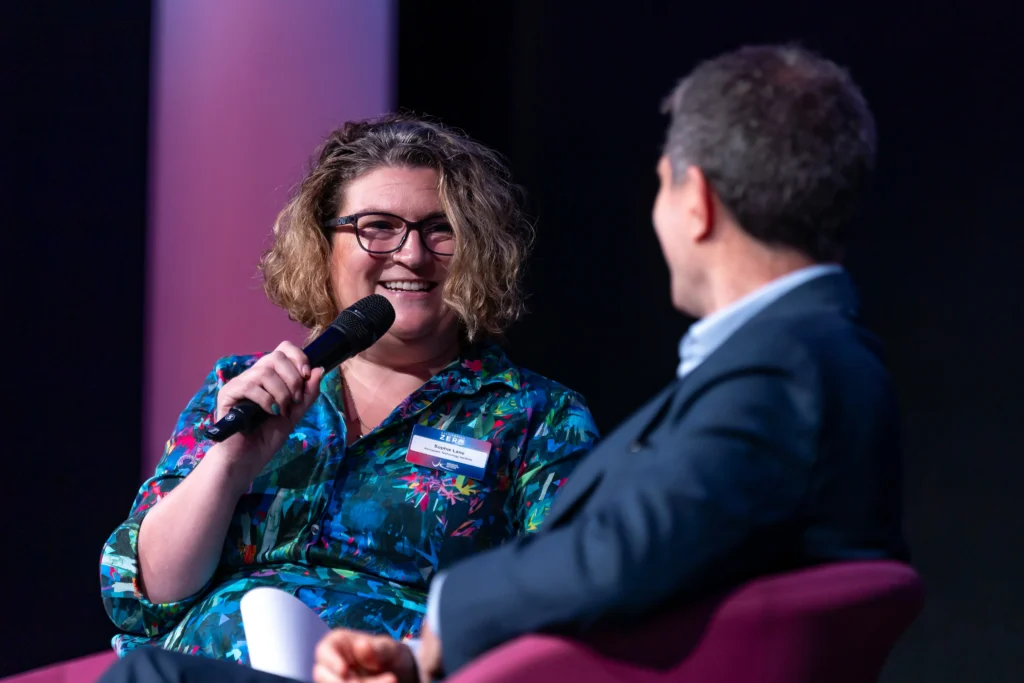
This week the ATI’s Head of Technology – Sustainability and Strategy, Adam Morton chaired a panel on Operation Blue Skies at the Brussels Contrails Conference. This revisited the story so far of the world’s first oceanic-scale contrail avoidance trial.
The Brussels Contrail Conference represents the only international forum dedicated to addressing contrails, with operational avoidance a major theme this year. It represented an ideal opportunity to dive deeper into the science, collaboration and innovation behind the project.
Organised by Transport and Environment (T&E), Green Transport Denmark and Blue Lines, the event brought together leading academics, policy makers, aviation businesses, media, NGOs and airlines. With these key stakeholders in the same room, the discussions that followed included the political and policy context, the latest contrails science, available mitigation incentives, and likely economic effects.
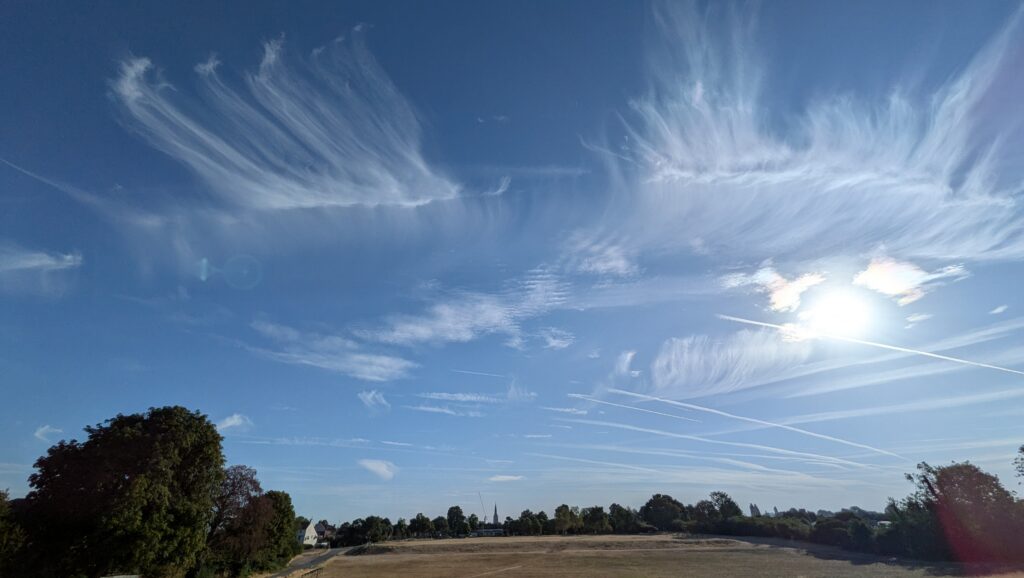
Project Operation Blue Skies, led by a Google team in the UK in collaboration with NATS, the University of Cambridge, Imperial College and the Met Office, became the Non-CO2 Programme’s fifth project earlier this year. It targets the small proportion of flights responsible for the majority of contrail warming, applying variation to avoid the Ice Super Saturated Regions (ISSRs) where persistent warming contrails tend to form.
One of the panel’s key themes on the day was the project’s level of ambition. Answers from the panellists emphasised the sheer scale of the project, which is orders of magnitude larger than any that have gone before. Being coordinated centrally by NATS, means the number of flights and trial-area can be increased dramatically. Attendees also heard that the ambition extends beyond scale with the project targeting a wide range of objectives. These include fully proving the science, building enhanced stakeholder confidence, fully evaluating future environmental benefits, and informing policy development.
A further key theme was how delivering this challenging project will require technical innovation across multiple fields. Each panellist was able to identify new methods and evolving technology to be deployed across modelling, imaging, analysis, and impact assessment. In a world first, Operation Blue Skies will use satellite-based imaging techniques coupled with AI to identify and track contrails in real-time and over large distances.
For the first time, specific details on the mechanics of the trial were shared with a much wider audience. This detail on what pilots are likely to see on a day-to-day basis demonstrated that airline operations and pilot interface have been thoroughly considered from the outset.
Since the project’s launch in August, the industry has been keen to hear more about trade-off between contrail avoidance, extra-fuel burn and reduced radiative forcing. The audience was reassured that participating aircraft will experience modest altitude changes, and as a result, additional fuel burn will be very low and more than justified by the wider non-CO2 benefits.
Panellists Kemal Armada (Google), Sian Andrews (NATS), Dr Jessie Smith (University of Cambridge) and Dr Marc Stettler (Imperial College). Organisers Joachim Majholm and Alexander Hansen.
To hear more about Operation Blue Skies alongside more of the ATI Programme’s non-CO2 projects, join the Beyond Carbon breakout session on Day 2 of the ATI Conference, ICC Wales, Newport 17th & 18th November. Buy your ticket here.