Some of the hardest problems we face won’t be solved by good intentions alone. We need innovation that gives us better choices. Aviation’s impact on the climate is one of those problems.
We know that reducing CO2 emissions will require major advances in aircraft technology, propulsion and sustainable aviation fuels. But CO2 is only part of aviation’s climate impact.
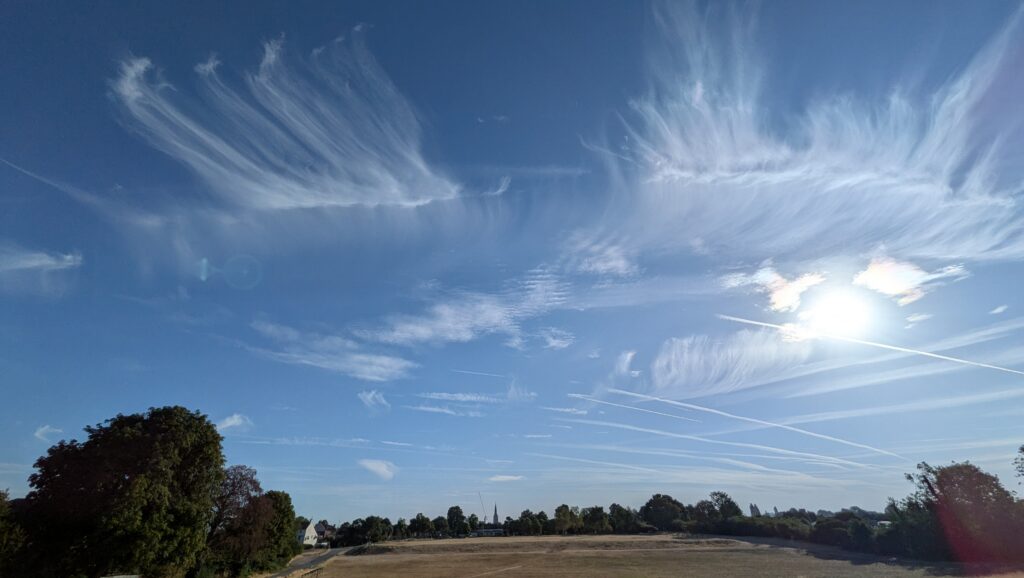
Warming contrails – the ice-cloud formations sometimes created behind aircraft – are estimated to account for up to half of aviation’s total warming impact. What if we could make relatively small changes to the way aircraft operate and reduce some of that impact? That’s the question behind ATI Programme project Operation Blue Skies.
The £5 million, 30-month initiative brings Google, NATS, the Met Office, Contrails.org, Imperial College London and the University of Cambridge together through the ATI Programme to test AI-enabled contrail avoidance across the North Atlantic.
The principle is relatively simple: use AI-informed data and forecasting to identify areas where warming contrails are likely to form, then explore whether small changes in aircraft altitude can safely avoid those conditions. The challenge is making that work in the real world.
From research to reality
Previous research and smaller airline-led trials have produced promising results. Operation Blue Skies asks the next question: can this work safely and effectively across a large and complex airspace?
The trial will focus on the Shanwick Oceanic airspace – the eastern half of the North Atlantic corridor managed by NATS. The North Atlantic is particularly interesting, the region is responsible for around 5% of global contrail warming impact. Its geography, atmospheric conditions and volume of traffic make it an ideal place to test whether contrail avoidance can work at meaningful scale. That shift in scale matters.
Innovation working in a model, laboratory or isolated trial is one thing, but it becomes exponentially more valuable when we can translate that idea into something that works safely, reliably and repeatedly in the real world. That’s what excites me about Operation Blue Skies.
It combines atmospheric science, AI, weather forecasting, aerospace expertise and air traffic management to tackle a difficult problem in a fundamentally practical way. We don’t yet know exactly what the trial will tell us, which is why the real word trails are crucial.
We’re taking promising science and technology and generating the real-world evidence needed to understand what works, what doesn’t, and what it would take to deploy an approach like this more widely.
Innovation can give us better choices
There is a broader point here too. Climate challenges are sometimes framed primarily around doing less or accepting difficult trade-offs. Innovation gives us another lever: finding smarter ways of doing things.
That doesn’t make contrail avoidance an alternative to decarbonising aviation. Far from it. Consistent with the ATI’s firs-of-its-kind Non-CO2 Roadmap, we need to understand how operational measures such as contrail avoidance can complement new aircraft technologies, propulsion systems and sustainable aviation fuels.
There won’t be one answer to sustainable aviation. We need to keep expanding the range of solutions available to us.
Why the UK?
The UK is exceptionally well placed to run an experiment like this. We have world-class aerospace capability, advanced weather and climate modelling, leading academic research and one of the world’s most sophisticated air traffic management systems. Operation Blue Skies brings those capabilities together.
It also demonstrates the partnership between the ATI and government, delivering Department for Transport funding through the ATI Programme and complementing the wider Aviation Non-CO2 Programme led by DfT and the Natural Environment Research Council (NERC).
Breakthrough innovation rarely comes from one organisation or one technology. It comes from bringing together the right science, engineering, technology, operational expertise and investment – and then creating the environment to test something ambitious.
That’s what we’re doing with Operation Blue Skies. Now we get to find out what works.
Find out more about the ATI’s work on aviation’s non-CO2 impacts in our Non-CO2 Roadmap.