With the indication from Boeing CEO David Calhoun earlier this month that Boeing would not introduce a wholly new large civil aircraft until the mid-2030s, what does this means for aviation’s chances of meeting Net Zero 2050? ATI Senior Technologist, Naomi Allen, considers the potential impact.In creating the UK technology strategy Destination Zero, the ATI modelled the environmental impact of a scenario for entry-into-service (EIS) dates for zero-carbon and ultra-efficient aircraft. Here, we take a look at how that scenario could change in light of Boeing’s announcement.The Destination Zero scenario assumed the introduction of a next generation ultra-efficient narrowbody aircraft in 2032. The revisited scenario delays that to 2037, accommodating possible delays in a potentially more complicated development programme. Knock-on impacts can be expected in other aircraft categories, with a zero-carbon narrowbody aircraft and ultra-efficient widebody aircraft also being delayed in recognition of the limited resources available for product development. (This is likely exacerbated by the difficulty in ramping teams back up after introducing an extended delay in development programmes.)Delaying the EIS of new large aircraft to 2037 increases the challenges of reaching Net Zero 2050, representing a 4.4% increase in overall tailpipe emissions in 2050, relative to the Destination Zero scenario. With fewer ultra-efficient aircraft in service, demand for Sustainable Aviation Fuels (SAF) would be higher or would place greater dependency on other mitigations including carbon capture and offsetting. The total SAF demand could be 501 Mt for this scenario, adding to the already significant challenge of delivering the volumes of SAF required to meet increasing flight demand.We also considered an alternative scenario: could the delay in a SAF-powered ultra-efficient aircraft permit the acceleration of a zero-carbon narrowbody aircraft into service? If the zero-carbon narrowbody aircraft from the Destination Zero scenario is brought forward to 2037 alongside the SAF-powered ultra-efficient aircraft, then the effect of the delay on the SAF-powered ultra-efficient side of the market could be mitigated. In this scenario, overall tailpipe emissions are held to a similar level as that seen in the ATI’s original Destination Zero scenario, as shown in the graph below.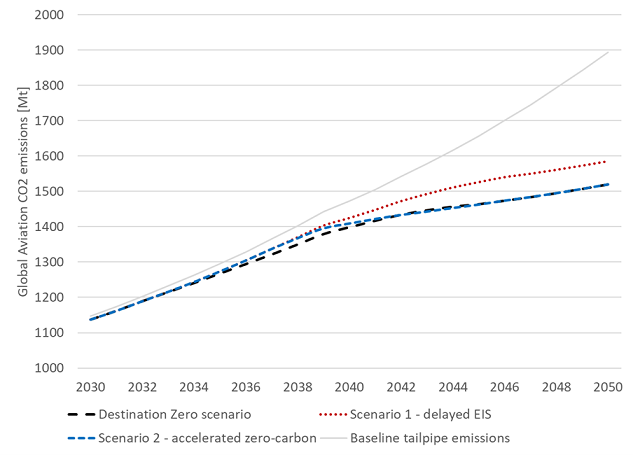 ©Aerospace Technology InstituteWhile these scenarios focus on the aircraft perspective, other factors will have a notable influence on the reality of the market over the next three decades. These include continued increase in customer demand, together with sufficient infrastructure being in place to produce and distribute the SAF and hydrogen fuels that new aircraft will need. It is here that policymaking by governments, airline requirements and public opinion will be critical in helping the sector to deliver low- and zero-carbon flight.As set out in Destination Zero, the ATI is supporting the development and maturation of zero-carbon, ultra-efficient and cross-cutting technologies. It is then airframers who determine when the market conditions are right to launch new aircraft exploiting them. In my view achieving Net Zero 2050 without economically-damaging restrictions on aviation growth can only be achieved through accelerating the development, certification and introduction of next generation technologies and aircraft. ©Cover image copyright: Boeing
Why aircraft entry-into-service dates matter for Net Zero 2050
Related articles

Operation Blue Skies takes flight at the Brussels Contrails Conference
Adam Morton chaired a panel on Operation Blue Skies at the Brussels Contrails Conference which revis...
21st October 2026

Blue sky thinking: How the world’s most ambitious contrail avoidance trial got off the ground
ATI Head of Technology – Sustainability & Strategy, Adam Morton, retraces the journey of the world...
10th September 2026

New ATI INSIGHT paper defines aerospace’s battery requirements
Published as experts meet for the first day of the Faraday Institution Conference 2026, INSIGHT: Aer...
8th September 2026