University of Nottingham
High Performance Transmission Systems Facility (HPTFS)

The three shaft test facility has enabled multiple industrial partners to investigate aero-engine phenomena at conditions in a flexible yet robust and secure testing environment.
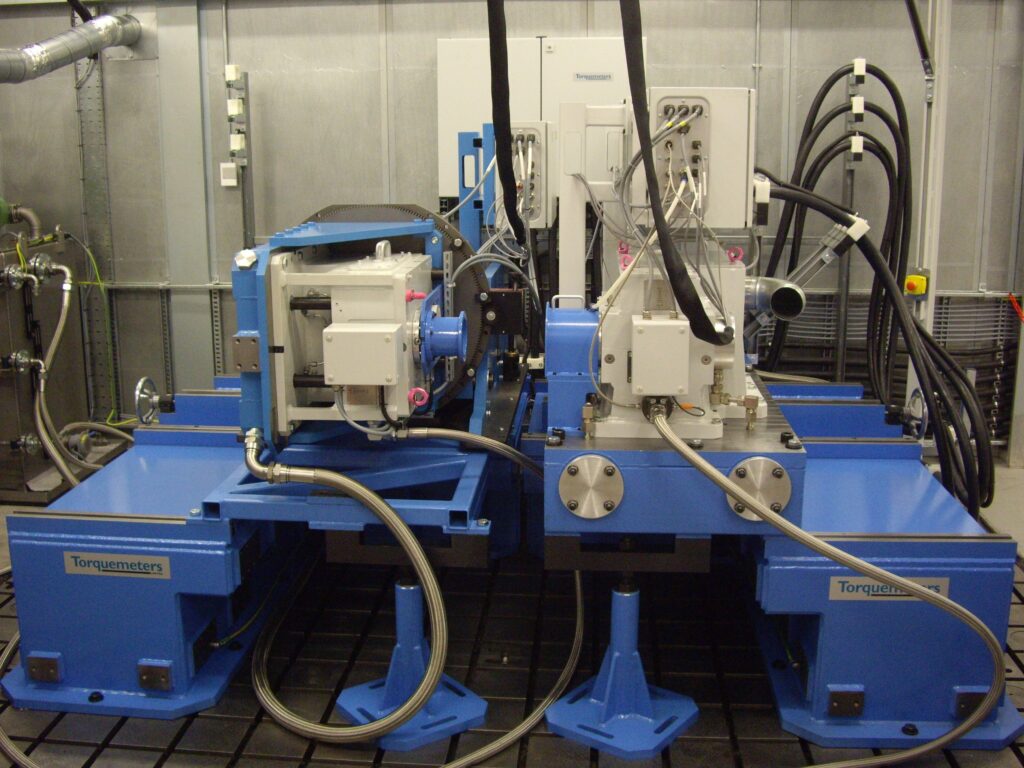
The three shaft test facility (3STF) consists of three independent drive shafts to provide comprehensive test capabilities supporting a range of specific investigations. Supporting the translation of mid-TRL research into high-TRL product development, it is fully equipped with air and oil services, controls and instrumentation and is designed to allow the use of a bespoke pedestal. This allows users to mount the drives and modify the position, the centre line height, axial spacing and orientation to achieve a wide range of configurations.
The facility has enabled multiple industrial partners to investigate aero-engine phenomena at conditions in a flexible yet robust and secure testing environment. This includes investigations into hydraulic seals as well as bearing chamber modelling. Beyond the scientific and engineering insights, the facility has helped support novel industrial and academic collaborations which may have not been possible otherwise.
Key features of the facility include:
- A total of three drive shafts: two drives with max speed of 35,000 rpm and the third with max speed of 60,000 rpm which can simulate a radial power off-take.
- Air systems that can accommodate three independent supplies and two vent lines
- Oil systems that can accommodate three independent supplies and three air/oil mix removal systems
- Accommodation of test modules to fit within a 1.5m x 1.5m x 1.5m envelope
- Instrumentation and a separate SCADA system for project-specific data gathering
Historically, experimental investigation and validation of the relevant behaviour of transmission systems involved full engine or system test runs whereas this facility can host laboratory-environment investigations.
3STF also supports the development of effective heat and lubrication systems in next-generation aero-engines. By enabling these engines to run at higher temperatures with less oil, greater engine efficiencies can be achieved. Capability to simulate a harsh environment, including elevated temperatures and pressures in the bearing chambers and cores of modern engines and gas turbines offers significant benefit to industry.
The rig has contributed to the expansion of a skilled workforce in designing, maintaining and running the facility. Multiple engineers, technicians, and experimental researchers are involved in the rig, with the learning applied into other projects.