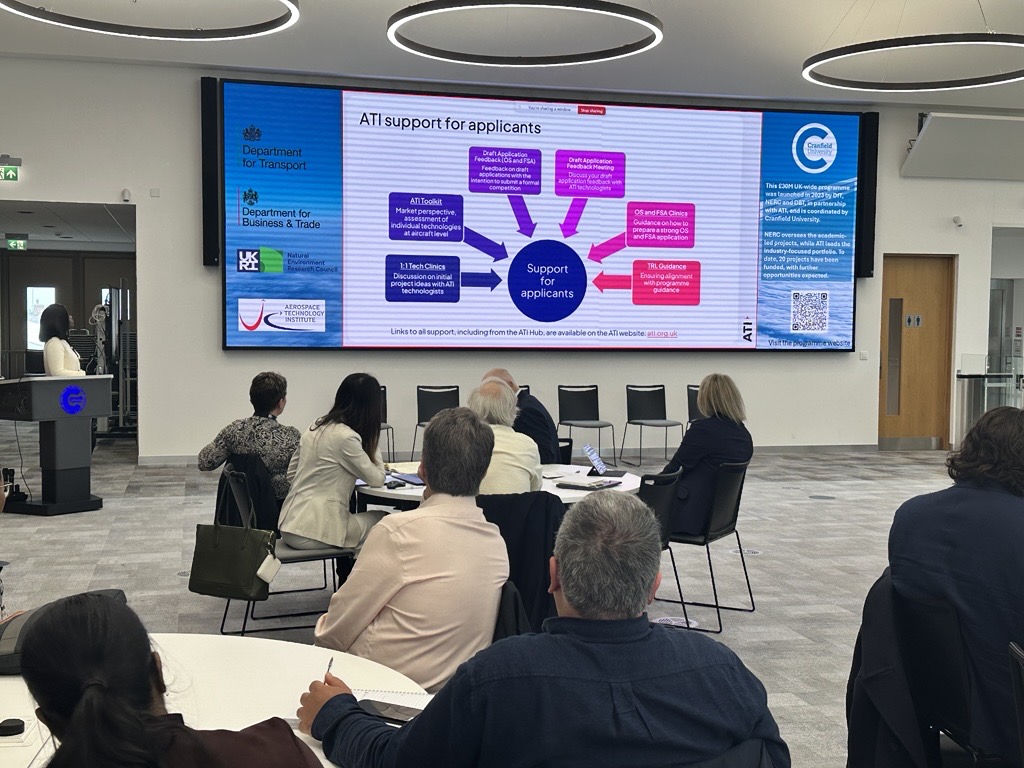
Rachel O’Malley, Lead Technologist – Sustainability & Strategy recaps the first joint meeting between teams working to research aviation’s non-CO₂ climate impacts, and develop technologies to address them.
This week, the Aerospace Technology Institute (ATI) and the Natural Environment Research Council (NERC) jointly welcomed researchers, industry and wider stakeholders to the first meeting on aviation’s non-CO2 impacts on the climate.
By connecting projects funded through NERC’s aviation non-CO₂ research calls with ATI Programme-funded applied aerospace research, the event created a valuable opportunity to share progress, discuss emerging findings and identify priorities for future work in a rapidly evolving field.
Aviation non-CO₂ impacts span a wide range of interacting processes, including contrail formation, nitrogen oxide (NOₓ) emissions, aerosol-cloud interactions and the influence of future fuels and propulsion technologies on atmospheric effects. Addressing these challenges requires expertise across atmospheric science, aerospace engineering, fuels, modelling, operations and climate policy.
Discussions highlighted both the breadth of work now underway and the need for stronger coordination across this emerging landscape. Topics ranged from contrail modelling and observational studies to future fuels, hydrogen combustion, strategic SAF deployment and climate metrics for future decision-making.
A clear theme throughout the meeting was the value of stronger connections between complementary activities in the UK and internationally, as aviation non-CO₂ work moves closer to informing policy, fuel strategy and the development and deployment of future aircraft and propulsion technologies. Better coordination across the community will be essential to sustaining progress and building capability in this strategically important area.
The meeting also underlined how complex and fast-evolving this field remains. Important uncertainties remain, particularly as the sector explores the strategic use of Sustainable Aviation Fuels (SAF), alongside hydrogen and other future propulsion pathways, and seeks to better understand how these developments may influence aviation’s wider climate impacts. Continued collaboration between academia, industry and government will be essential to ensure that emerging mitigation approaches are scientifically robust, operationally realistic and internationally relevant.
There was strong interest in maintaining and building on this momentum through future workshops, greater international engagement and improved coordination across the wider landscape.
The ATI would like to thank all speakers, participants and organisers for contributing to an engaging and constructive event. The discussions demonstrated strong capability in this area and reinforced the value of continued collaboration as the aviation sector works towards lower climate impact flight.
Find out more about the NERC Aviation’s non-CO2 impacts on the climate programme here and the ATI Non-CO2 Programme here.
Click here to discover projects already underway.