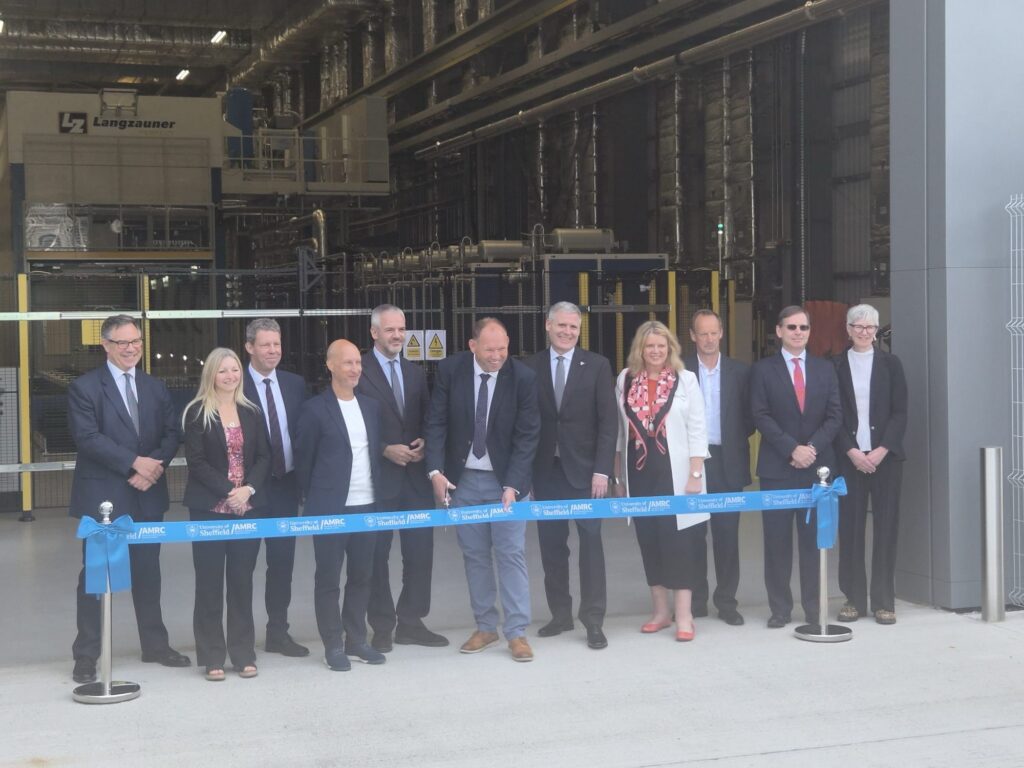
The opening of the Composites at Speed and Scale (COMPASS) open-access research facility at the University of Sheffield AMRC today marks an important milestone for UK aerospace.
The ATI’s Engineering Growth strategy sets out an ambition to double the value of UK aerospace from $9 billion to $18 billion by 2035. Facilities such as COMPASS show how by working with industry we can develop, test and industrialise the advanced manufacturing capabilities needed to achieve this and compete on the world stage.
The significance of COMPASS is underlined by its first major project, Boeing’s Isothermic High-Rate Sustainable Structures (IHSS), also funded by the ATI Programme. Future aerospace platforms will demand unprecedented production rates alongside improved efficiency and lower emissions. Meeting that challenge will require more than innovative materials and designs; it will require the ability to manufacture advanced composite structures reliably, competitively and at scale. The ATI’s ongoing work in developing advanced manufacturing technologies is an important part of turning world-leading research and development into tangible economic gains for the UK.
This is where COMPASS can make a real difference, and the ATI is proud to have supported the facility, including through the ATI Programme with £29.5m in grant funding for the state-of-the-art equipment housed there.
Our work on composites highlights a significant opportunity for the UK. Analysis shows a clear pathway to grow the value of the UK’s aerospace composites market from £726 million in 2022 to more than £4.5 billion by 2050, driven by increasing production volumes and future aircraft programmes. Capturing that opportunity will depend on developing integrated, certifiable and scalable systems capable of delivering at rates never previously seen.
COMPASS demonstrates the long-term impact of the ATI Programme and the value of collaboration between industry, government and academia. ATI Programme investments have helped establish the foundations of the UK’s aerospace composites capability, supporting technologies and infrastructure that strengthen competitiveness and prepare us for future platforms. Alongside initiatives such as Airbus’ Wing of Tomorrow and Rolls-Royce’s UltraFan, facilities like COMPASS translate innovation into industrial readiness and economic opportunity.
Just as importantly, COMPASS is an example of how aerospace delivers place-based growth across the United Kingdom. South Yorkshire has established itself as a globally recognised centre for advanced manufacturing, with the University of Sheffield and the AMRC at the heart of an ecosystem that brings together industry, research, innovation and skills development. Investment in COMPASS strengthens regional capability, supporting high-value jobs and attracting investment.
Importantly this extends beyond civil aerospace. Advanced composites are key to defence. The UK’s ability to design, manufacture and industrialise these technologies is a strategic national asset. By strengthening domestic expertise, infrastructure and supply chains, facilities such as COMPASS help build sovereign industrial capability.
The opportunity before the UK is significant, but realising it will require coordinated action. Next week at Farnborough International Airshow, the ATI will publish a new composites Framework for Growth setting out a shared roadmap to strengthen UK competitiveness in one of aerospace’s most important future growth markets. The ATI team will be at Farnborough to discuss this and more, now is the time to engage.
If the UK is to double the value of its aerospace sector by 2035 and capture the multi-billion-pound composites opportunity beyond, the sector must move forward together. The foundations are already being built in facilities such as this. The challenge now is to turn that momentum into delivery.
The ATI Programme is delivered in partnership between Aerospace Technology Institute, Department for Business and Trade and Innovate UK.