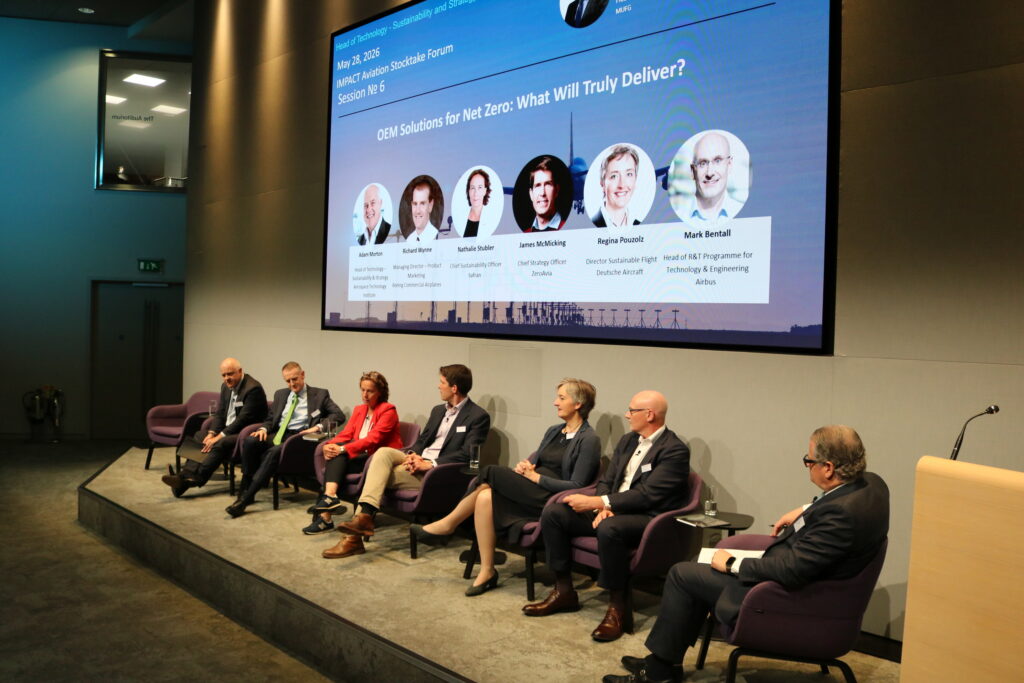
The ATI’s Head of Technology for Sustainability and Strategy, Adam Morton, joined a panel on Original Equipment Manufacturer (OEM) solutions for Net Zero at the IMPACT AVIATION STOCKTAKE FORUM in May. Here he discusses its key themes around how OEMs can contribute to the sector’s decarbonisation and sustainability commitments.
The 2026 invite-only IMPACT Forum brought together leading scientists, policy makers, airlines, OEMs and investors. The event provides a forum to assess progress on decarbonisation measuring delivery against commitments. Its wide-ranging agenda covered fuels, aircraft technologies, operations and policy over two days.
The OEM panel was chaired by Michael Halaby (MUFG) and also included Mark Bentall (Airbus), James McMicking (ZeroAvia), Regine Pouzolz, (Deutsche Aircraft), Nathalie Stubler (Safran) and Richard Wynne (Boeing).
A key question put to the panel was what aircraft technologies will move the needle by 2035? This was a timely discussion with the ATI publishing the latest UK aerospace technology strategy Engineering Growth the week before. This blueprint for sustainable economic growth anticipates launch of a next generation single-aisle aircraft programme around the end of this decade, with entry into service (EIS) in the second half of the 2030s.
Re-engined wide body aircraft and ultra-efficient turboprop designs are also expected to arrive at or beyond the 2035 time horizon. Wings and engines represent the most significant technology levers for improving efficiency and reducing emissions on future commercial aircraft. They also promise the most significant return on investment and UK’s strengths in these capabilities mean we have a key role to play in the delivery of these ultra-efficient aircraft.
Before then, short-term OEM contributions to decarbonisation will largely be achieved through latest-generation aircraft entering into service. These are expected to be up to 30 percent more efficient than the fleet they replace thanks to more efficient engines and aerodynamics, and wider structural and system improvements.
Over the longer term, ATI analysis shows demand for over 65,000 new aircraft deliveries between 2025 and 2050. With a large proportion of these expected to incorporate technologies from the ATI’s latest roadmaps, improved aerodynamics, advanced propulsion, and lightweight structures and systems are projected to deliver major fuel burn and emissions reductions.
The ATI’s latest targets include 25% and 20% fuel burn savings for next generation single-aisle and widebody aircraft, respectively. The corresponding aircraft weight savings are 20% and 12% for single-aisle and widebody, while both aircraft types are targeting a drag reduction of 10%.
Whilst such fuel saving benefits will be dominated in this timescale by advances in engines and wings, all of the major systems have an important role to play. Industrial competitiveness technologies hold the key to unlocking these reductions by delivering at the required rate, cost and quality across advanced materials, design methods and competitive manufacturing processes.
With the 2026 IMPACT FORUM taking a long-term holistic view, the conversation moved on to what technologies emerge over the longer term including out to 2070. It is in this timescale that zero-carbon emission technologies make a sizeable impact, and the decarbonisation potential of these aircraft grows. The ATI’s latest assessments estimate that zero-carbon emission regional aircraft will enter-into-service in the 2040s. With time for penetration into the fleet, our in-house sustainability modelling and work by others, shows this having a rapidly growing contribution to carbon avoidance from the 2050s onwards. It is therefore crucial that developing technologies across energy storage, fuel system, power distribution and control technologies remain part of the UK’s long-term strategic direction.
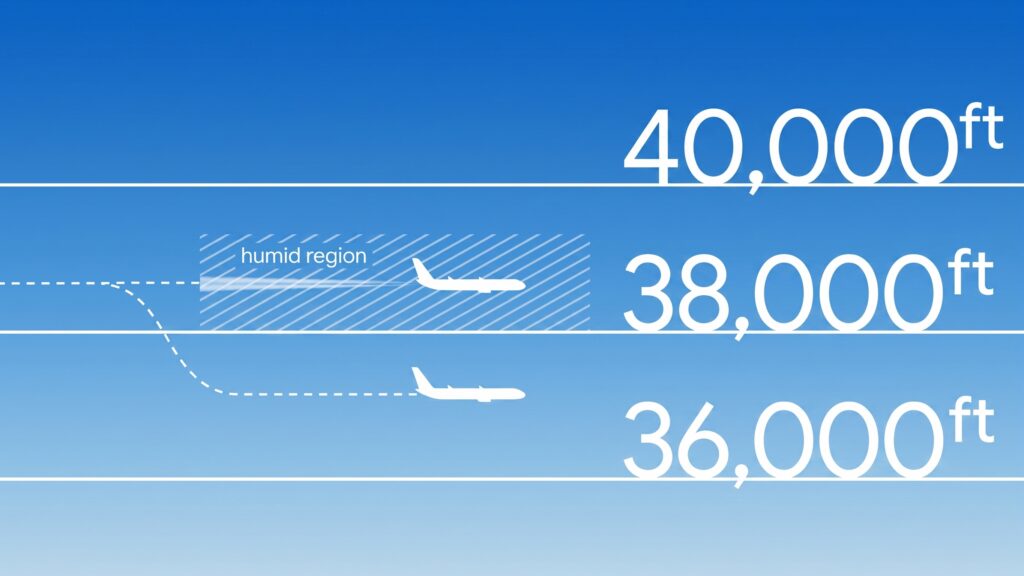
The 2026 IMPACT FORUM also looked to dispel myths and misconceptions and addressing these for investors is key. There was consensus around the need to recognise the importance of other environmental impacts beyond those from carbon emissions. In particular, with growing evidence that other Non-CO2 emissions may have a warming effect equal to or larger than carbon dioxide, investors will increasingly need to build effects from contrails into their investment decisions. While it was recognised that policy around non-CO2 emissions is much less mature, Europe is leading the way on monitoring the broader environmental impacts of aviation. Expectations that this will translate into future management requirements partly explains the why the ATI and others are so active in this space.
Discover more about the UK aerospace technology strategy on our Engineering Growth webpage and watch our webinar on demand on YouTube.